2026-11-24 · 4 min
#diffusion#dit#wavelet
37ms Without VAE: 2D Haar Wavelet Direct Pixel Heads for DiT
Why full-res GroupNorm stalls on memory bandwidth, and how half-res Haar wavelets + LL-detached PatchGAN achieve 39.2 dB portrait fidelity.
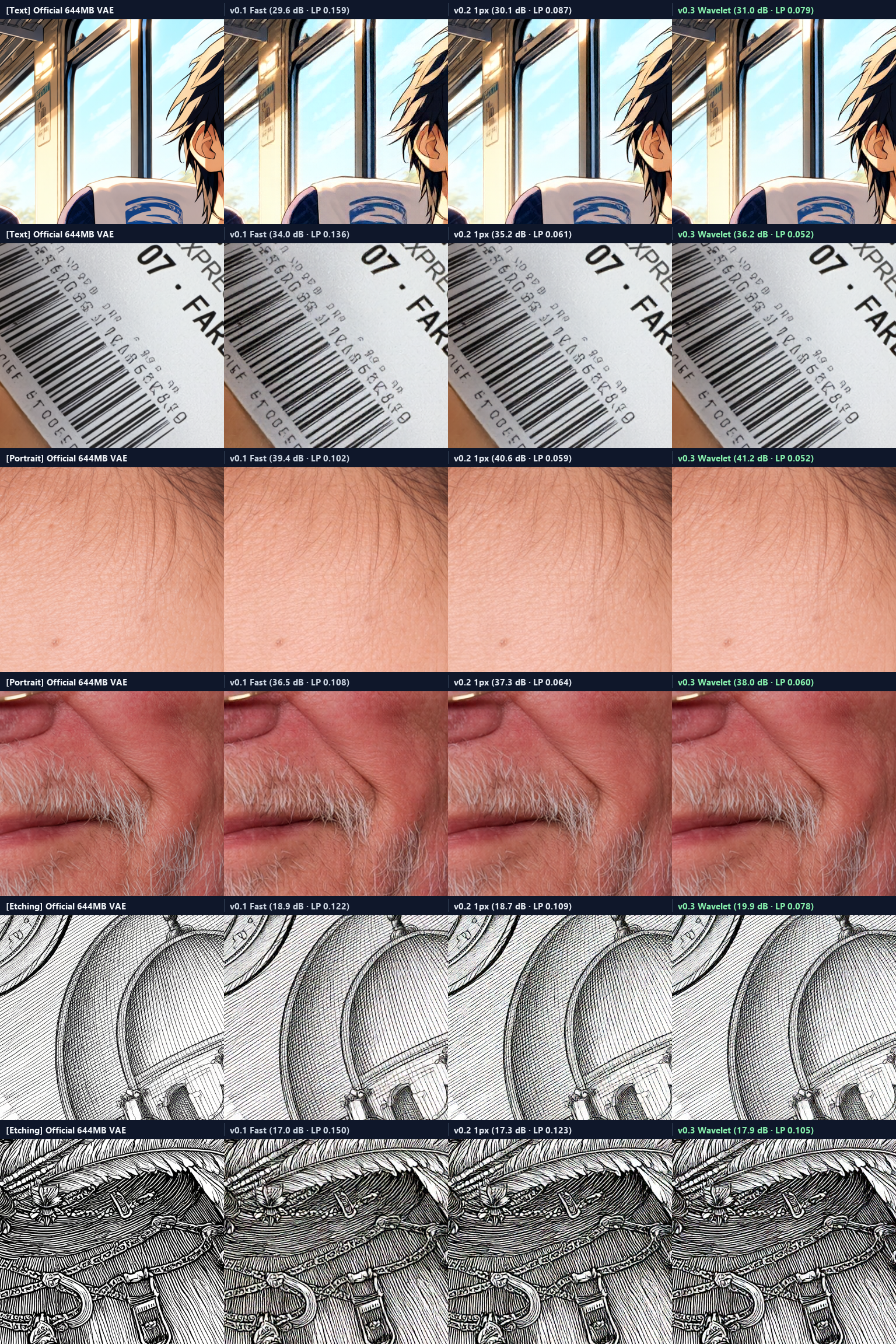
The 3-Generation Progression (NVIDIA L4 · 1024×1024)
| Variant | Architecture | Latency | Peak VRAM | Portrait PSNR | LPIPS ↓ |
|---|---|---|---|---|---|
v0.1 |
8px ConvNeXt + Pixel MSE |
7.77 ms | 340 MiB | 37.4 dB | 0.1524 |
v0.2 |
1px Full-Res GroupNorm + LPIPS |
115.05 ms | 904 MiB | 38.4 dB | 0.0891 |
v0.3 |
2px Haar Wavelet + LL-Detached GAN |
37.51 ms | 504 MiB | 39.17 dB | 0.0736 |
Three Engineering Takeaways
- Terminate Neural Layers at Half Resolution (
H/2 × W/2): Full-res1024²GroupNormis strictly memory-bandwidth bound (115 ms). Predicting 2D Haar sub-bands(LL, LH, HL, HH)at512²followed by parameter-free analyticiDWTcuts latency 3.07× and saves 44.2% activation VRAM:
- Bridge Token Seams with
3×3LatentSpatialHighway: Pure1×1token projections break diagonal text across16×16patch seams; injecting3×3latent convolutions into8px / 4px / 2pxlayers raises micro-text PSNR to 36.2 dB. - Lock Low Frequencies in Wavelet PatchGAN: Detaching
LLisolates adversarial gradients to high-frequency edges, eliminating GAN color drift:
d_input = torch.cat([pred_LL.detach(), pred_LH, pred_HL, pred_HH], dim=1)